


Ubuntu Fine Art gazes at one of Taylor’s pieces, ‘Ease.’ (Photo: nell mills)
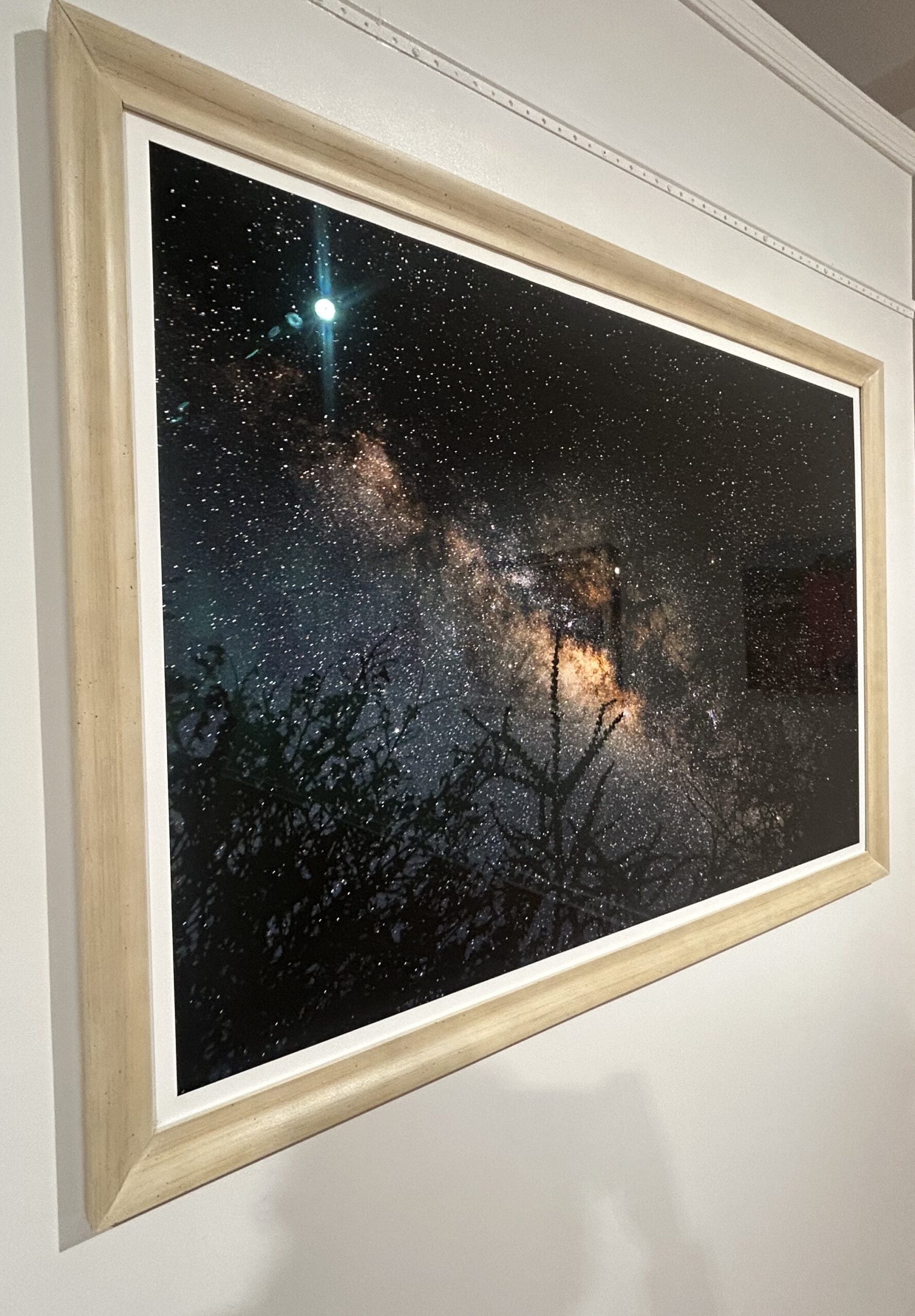
Thirty seconds. That’s the length of time photographer Steven CW Taylor had to position himself, motionless, in the Kenyan bush to capture the surrounding night sky. Wanting to compress the sensation of being inserted into a shaken snow globe, he understood that the vast darkness would require a slower, extended exposure.
This Is Us. Stardust was the first work I noticed when I entered Ubuntu Gallery on a rainy winter afternoon. Its commanding, centered placement and shadowy palette—so distinct from the gallery’s daylight atmosphere and the surrounding works—was magnetic. I wanted a closer look, but the space was already alive with viewers, collectors, and families, many gathered around that particular image. By the time the crowd thinned enough for me to approach, the artist talk I had come for was beginning, leaving me with no more than thirty seconds with the photograph that first caught my eye.
In a conversation, back in January this year, sponsored by The Colored Girls Museum, Steven CW Taylor shared the inspiration and backstory behind his solo photography series, Unbound: A Visual Study on the Nature of Freedom.
Curated around a trinity of trips to Kenya, each location clarifies and complicates his definition of freedom. As one moves through the gallery, freedom shifts from the ease of slow island life in Lamu to the vulnerability and expansiveness of sleeping overnight in the Kajiado bush, and finally to the lived constraints of the crowded town of Kibera.
The photographs from Lamu are immersive, uncomplicated scenes that ask rather than demand interpretation. Small details emerge that transport us into the bright landscapes, as in The Navigator, where the upending perspective plunges us underwater.
A woman stands in front of the opening photo and points the vibrant mangrove tree out to her two young children— “this would be a nice climbing tree right here!”—and they nod in agreement.
Hidden in the Mangroves depicts two young boys among a flourishing mangrove forest on a tranquil white sandy beach. Centered in the tree’s crook, one boy looks outward, welcoming us.
When discussing the liberating freedom he felt in Lamu, Taylor introduces the audience to the Kenyan phrase “pole, pole,” which translates to “slow, slow” in Swahili. This oft-repeated phrase operates less as metaphor than as instruction—to remember to linger, to resist urgency.
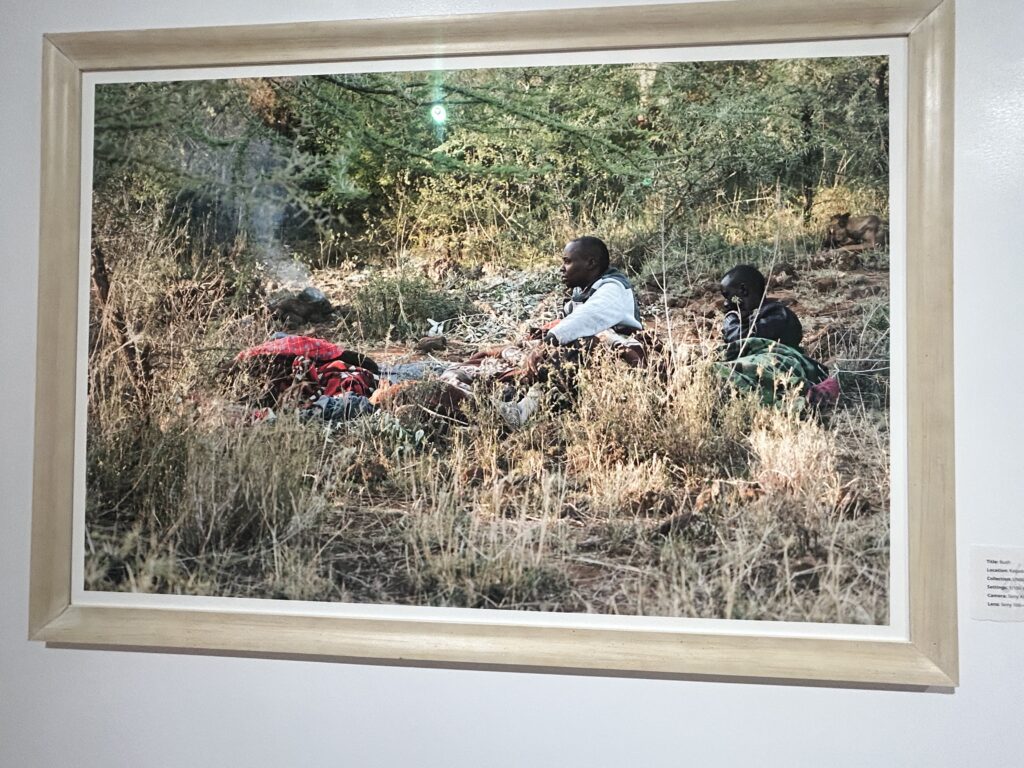
Time stretches upon entering Kajiado, where Taylor curates an unfolding, expansive narrative from a series of photos taken throughout a single day and night. The varying textures and strong subjects transport us into the bucolic bush among the Maasai. On the back wall, painted jet black, two bolts of the distinct plaid shuka fabric hang like tapestries, framing two pastoral landscapes where candid portraits emerge.
In Bush, two men rest alert on their elbows among stalks of sharp, browned grass, wrapped comfortably from the waist down in shuka fabric. Wisps of hazy smoke, carried by the passing breeze, suggest an unseen fire nearby. Crisp, needled branches hang sternly overhead as the setting sun frames the men in profile, their gazes fixed on the horizon.
Taylor’s Unbound grew out of a question that first surfaced years earlier while he was noticing birds in flight and wondering whether he could live as freely as they did. Watching them, he realized that freedom was circumstantial and complicated.
“Despite their unencumbered flight,” he noted, “the birds were still at the mercy of the wind.”
Taylor confronts the constraining circumstances of freedom in the final site, Kibera, where the openness and expansiveness of the earlier sections compress into a series of crowded, active scenes. Here, the lush greens and blues of sky and sea give way to the pallid, dusty tones of cracked earth.
Of Contemplation is one of the final works in the series. A cloudy, subdued sky hangs over a fractured scene: a crumbling stone bridge divides into a residential street lined with boxy, hand-nailed homes. Figures move alone or in pairs, caught mid-step and blending into the background. Yet at the center, where the roads converge, a subject emerges—fixed in posture but tonally dynamic. He stands rooted and still, oblivious to the background motion, gazing toward whatever lies beyond the bridge.
After the artist talk concluded, I returned to the piece with pole, pole in mind. With no need to rush, I lingered. Looking again, I realized that the sky isn’t black, but saturated with blues, turquoise, purple, and shadow—colors bursting and blending like a spreading bruise.
The perspective places me among the sky rather than beneath it.
Light pricks through millions of stars like an afterthought, while a glowing haze of cosmic dust smolders. Leaning in, I finally see that the stars are not static pinpoints of light but mutable, in motion, continuing their drift whether I slow down enough to notice.
Unbound: A Visual Study on the Nature of Freedom is back on display at Ubuntu Gallery on 5423 Germantown Avenue.
nelle mills is a freelance writer and educator based in Germantown, where they’ve lived with their partner and cat for the past two years.