

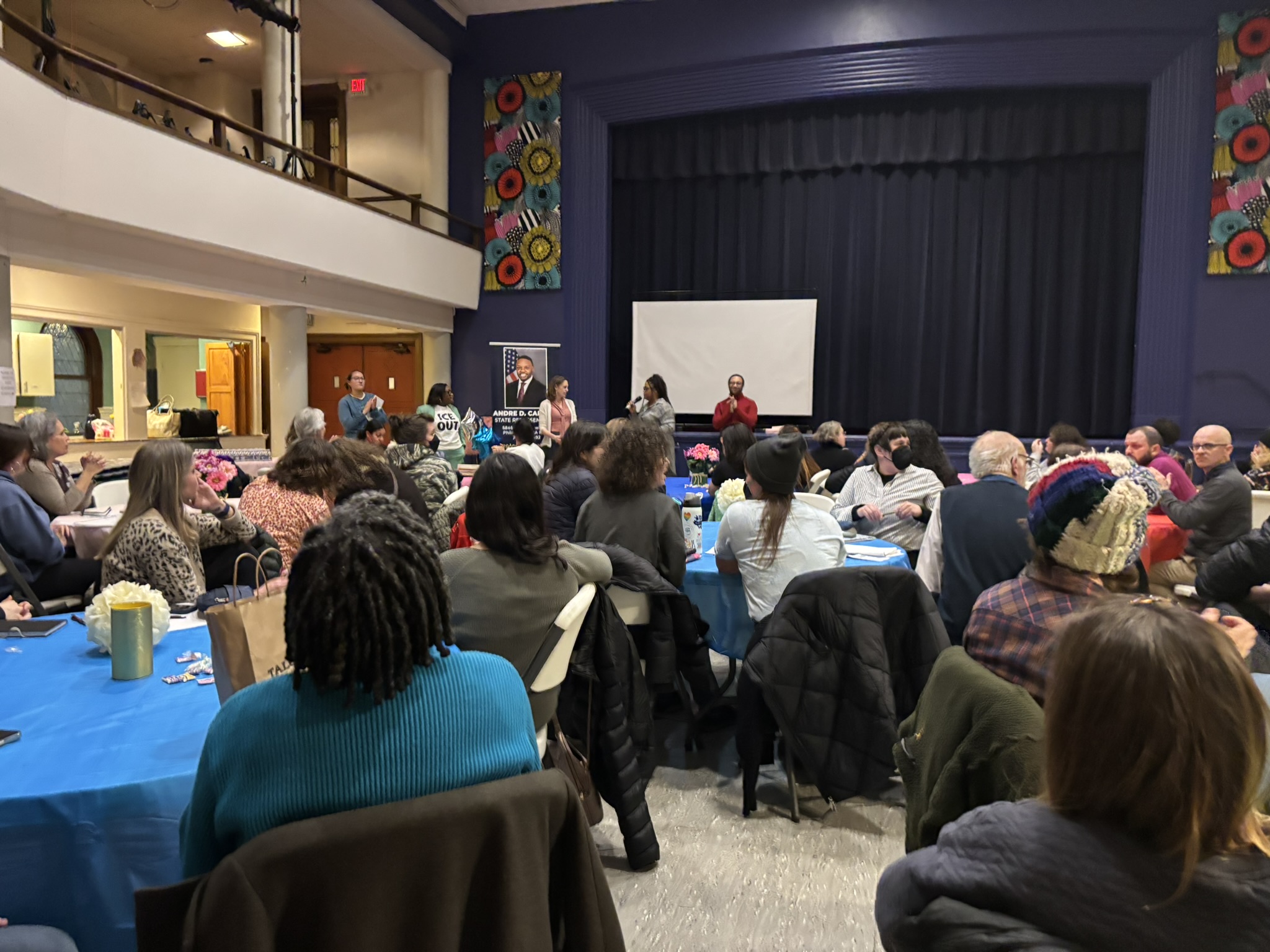
An ICE Out Training at First United Church of Germantown (FUMCOG) in Germantown earlier this year co-sponsored by State Representative Andre Carroll’s office. (Photos used with permission from Councilmember Kendra Brooks’ office.)
It’s been a year of ICE Out trainings hosted by Councilmember Kendra Brooks and her team, in partnership with organizations and community leaders across the city.
Since summer 2025, Brooks’ office transformed the trainings into a community-defense tool and organizing mechanism. According to the team, they’ve hosted more than 60 sessions, reaching more than 3,000 Philadelphians, with 150 becoming new trainers.
The trainings, held across the city, including Germantown, were in-person workshops that taught people how to respond as bystanders to ICE agents safely and explained their legal rights at work, at home, and in public.
They also included roleplaying different scenarios for when ICE officers show up, along with guidance on how to respond and support at-risk neighbors safely and legally.
Brooks’ team invited people who took part in the trainings to a gathering at the end of July to celebrate and reflect on the past year and what comes next.
How the trainings started and what’s changed
Kathleen Melville, communications director for Councilmember Brooks, and her colleague Glen Forster, legislative director, helped coordinate the trainings last summer.
The office knew they had to plug in somehow to the work being done in response to ICE officers and their actions all across the country, especially because their constituents were reaching out with an urge to participate right in their neighborhoods.
“When things are really difficult, especially on the national level, how do we find ways locally to connect with our neighbors, to build power, to show solidarity? And I think that these trainings have been a really great way to do that,” said Melville.
They partnered with the National Domestic Workers Alliance and the Philly Black Workers Project to develop the workshops. Their first training was hosted by Brooks’ office with Philly Queer Fundy, co-founded by Forster.
They were also working on legislation in response to ICE in Philadelphia and knew the community trainings complemented that effort.
“I think the real beauty is that I’ve watched all these different grassroots groups, political groups, religious groups, nonprofits, find their lane and offer something so that when a citizen is outraged by what they’re seeing, there’s all these different lanes to on-ramp into the work and into the advocacy. And that’s really beautiful and necessary,” said Senior Pastor Alisa Lasater Wailoo of First United Methodist Church of Germantown (FUMCOG), who hosted a training in Germantown this past February.
The FUMCOG training was in partnership with State Representative Andre Carroll’s office, and Melville said many trainings also involved local elected officials, neighborhood organizations, and businesses.
Germantown native and 59-07 Democratic Ward Executive Committee member Michael Byrd attended the training at FUMCOG because he wanted to understand what was actually happening instead of just reacting to headlines.
“I think in general, the trainings are important, but I also think that people say it’s just politics, and I think in general, it is deeper than that. Human dignity shouldn’t be political,” Byrd said.
He took away many points from the workshop. Still, one that stood out was the importance of recording incidents and documenting what actually happened in case people needed it for legal or other support.
Brooks and her team were consistently impressed by how each neighborhood showed up for the trainings.
“It kind of just clarified something I say all the time- we are community. Like we have us. We got us,” said Brooks.
Melville said one thing they learned quickly was that in-person training mattered. Online trainings were a thing, but folks liked meeting their neighbors and being in community with everyone.
Melville pointed out that in person, people can feel what their bodies might do when safety is threatened and practice using their voice. The office has heard that roleplaying is one of the workshop’s most valuable parts.
It can also be triggering though, especially for people whose loved ones are being targeted rather than watching from the sidelines. Melville said the team has adjusted the trainings over the year, given warnings, clarified who they are for, and added mutual aid organizations people can donate to after the workshops.
Impacts and what’s next
The trainings had multiple impacts, starting with strong participation.
“I think the biggest one is just seeing people. And we say at the beginning of the training that the goal is to sort of socialize bravery, for people to start to feel a little braver in the way that they can stand up in this moment. And I think we’ve seen that a lot,” Melville said.
And with that participation came action. Councilmember Brooks and Melville both agree that because of the large amount of support, participation, and citizens reaching out to councilmembers throughout the year helped the passing of the ICE Out legislative package of seven bills.
City Council passed the seven-bill ICE Out package in April. Mayor Cherelle Parker then signed six of the bills May 7, while the seventh passed without her signing.
“I’m really humbled by the showing of support that we got from the trainings, whether it’s people that hung their signs or called councilmembers or came to City Hall, to show support for the legislation. That was really huge,” said Brooks.
“The participation helped us move the needle,” she added.
Brooks and Melville agree — now that the legislation has passed, it needs to be enforced.
“It’s not enough to just have these laws exist on paper. They’re only meaningful if the city employees get trained on what they need to do to uphold the law,” the Councilmember said.
Melville said the seven bills were scheduled to go into effect on July 7, 2026.
As of late July, several actions still had not been implemented, including posting signage in city spaces, training city employees on warrants, and what to do when asked about someone’s immigration status.
Melville said the team is concerned about election season approaching and possible ICE interference at the polls. They want to ensure city employees know what they are authorized to do and are continuing to work with partners and community organizations to prepare for election defense work.
She says other impacts have included people organizing to make trainings more accessible and businesses creating workplace plans if ICE shows up. She said that one restaurant even built a code system into its menu to alert employees when ICE was there.
Councilmember Brooks’ team continues to work with organizers across the city as fall approaches, reflecting what Melville says Brooks likes to bring to City Council: collective organizing and co-governance, asking people what their needs are, what they want to see, and how to do this together.
Pastor Lasater Wailoo sees the work that still needs to be done and how churches, community organizations, and everyday neighbors are organizing around immigration justice, and she appreciated the approach of the councilmember’s trainings.
“There is an America we’ve proclaimed to be that we haven’t been, that we can choose to be, and we can build it together. And I am hearing that, and I’m feeling that, and I believe people are trying to build that together,” said Pastor Lasater Wailoo.
Lasater Wailoo urges neighbors in Germantown and surrounding neighborhoods to reach out to FUMCOG to plug into its immigration justice work and action.
Melville says the team plans to add new trainings in August. Check here for details and to register for upcoming workshops: training.iceoutphilly.org.

Maleka Fruean is Germantown Info Hub’s community organizer, a writer, and mother of four, all raised in the Germantown neighborhood of Philadelphia. She has a B.A. in journalism from Temple University and an M.F.A. in creative writing from St. Joseph’s University, and uses both to embrace the power of stories.