

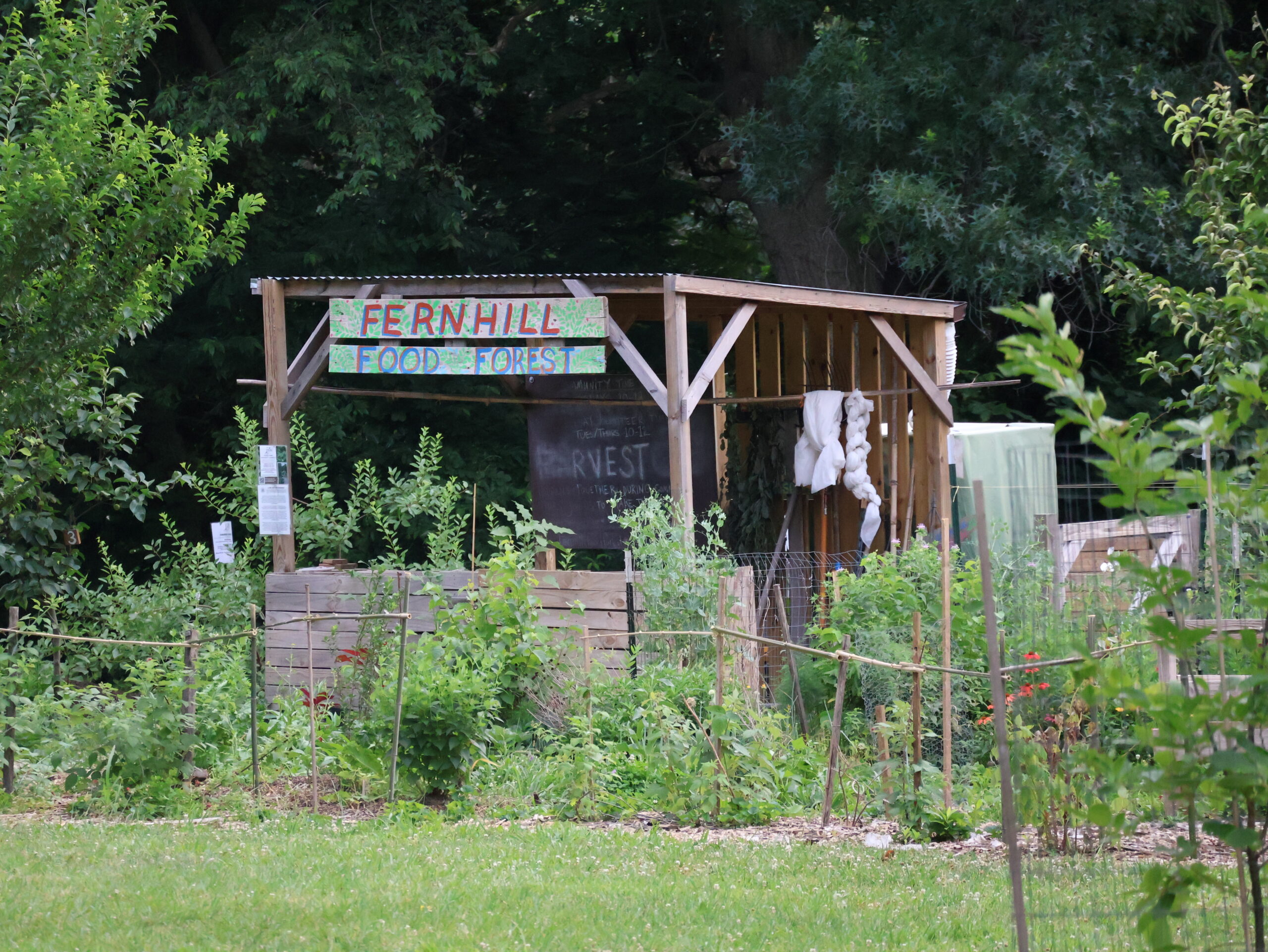
Fernhill Food Forest. (Photo: Rasheed Z. Ajamu)
On Monday, Aug. 10, District Attorney Larry Krasner and the DAO’s External Engagement and Government Affairs Division announced $240,000 in violence-prevention microgrants for 26 community-based nonprofits.
Of the 26 citywide organizations chosen with a focus on neighborhood beautification, four are Germantown-based, including Fernhill Food Forest, Northwest Victim Services, TEAM INC, and West Central Germantown Neighbors.
These grants aim to help organizations revitalize neglected public spaces, engage neighborhoods through ecological justice education, and promote environmental improvement efforts across Philadelphia communities.
Outcomes will vary depending on whether we provide opportunities and organize programs for neighborhood beautification, environmental improvement, and community safety initiatives.
In a press release, District Attorney Larry Krasner said this round of the DAO’s Violence Prevention Grant Initiative awards, distributed since May 2021, comes at a significant time.
“August marks 59 consecutive months of declines in violent crime in Philadelphia,” he said, before highlighting the impacts beautification and blight reduction have on neighborhoods.
“[It] not only improves the quality of life, but it strengthens the sense of community that enables neighborhoods to thrive. These organizations should be applauded for their dedication and commitment to keeping our communal spaces accessible.”
In the same release, G. Lamar Stewart, chief of the DAO’s External Engagement & Government Affairs Division, added, “Since 2021, the DAO has been intentional about reinvesting into communities that have been disproportionately harmed by violent crime, and we are seeing the fruits of that labor pay off with the continued decrease in crime.”
Fernhill Food Forest
The Fernhill Food Forest within Fernhill Park was awarded $10,000. They’ll use it to support building a second, “outdoor classroom” style food forest on the park’s lower level, across from Wissahickon Charter School.
That comes with a broader plan to clear invasive plants and expand youth programming.
Core team member Sumi Narra described the park’s role in the community: “Our park is this gem that we have in this neighborhood. It is our common backyard. It is our front porch.”
The funds will support a seasonal crew, hiring local neighbors and volunteers, including teens, to remove invasive species such as multiflora rose and porcelainberry in half-acre increments and replace them with native fruit-bearing trees.
They will also fund a local environmental youth educator and a 10-week permaculture course, to be run twice over the next couple of years.
Narra said the goal of their project goes beyond beautification.
“We’ve noticed that when we’ve had programming in the park for the kids in the neighborhood, as opposed to on a block or in the street, there is a very palpable difference,” she said. “They seem to be more calm. There seem to be fewer fights.”
Costs exceed the grant amount, so the project is being pieced together with other funding sources, including the Chesapeake Bay Trust and the USDA.
When asked how the group will know whether the project actually reduces violence rather than just beautifying the park, Narra said the effects take time to show up.
“Violence prevention, substance use reduction, safety in the neighborhood — all of those things do not come quickly,” she said. “It does not come with one solution. It has to be multifaceted.”
She pointed to young folks who once vandalized park property and now help protect it as an early sign of that shift: “They’re the ones who are now kind of on the community building team, and they’re the ones who are watching out and protecting those spaces.”
In an email, fellow core member of the forest, Jaron Olevsky, gave his honest answer to the question.
“This is difficult to measure. We are lucky to have Mekia (Elizabeth) and Heim (Brown), who are as connected to the local youth as anyone could be, residents who have been here for generations, and many other caring and engaged community members. Their combined experiences and perspectives are probably the best gauge we have.”
Northwest Victim Services
$20,000 grantee Northwest Victim Services (NVS), located at 6023 Germantown Avenue, has big plans in the works. They plan to create a fund to aid crime victims often overlooked by existing programs.
NVS Executive Director and founder Melany Nelson said some victims “slip through the cracks,” including carjacking victims, stolen-vehicle victims, arson victims without homeowners insurance, and seniors affected by gun violence. Because of that, their needs — such as property damage — often do not qualify for traditional victim compensation.
She says these are not mere beautification efforts but acts of restoration, preventing abandoned cars and deteriorating properties from taking over the streets.
The funds will serve four police districts in Northwest Philadelphia: the 5th, 14th, 35th, and 39th, reaching victims across neighborhoods from Roxborough and East Falls to Chestnut Hill and, of course, Germantown.
Nelson plans to work with all four police districts to develop “realistic requirements,” including requiring police reports for verification.
“We won’t be able to help a whole, whole lot of people, but we will be able to help some,” she told GIH.
When asked how the group will measure the effectiveness of this project, the executive director said they will track assistance by ZIP code and neighborhood to evaluate whether the fund is actually effective in prevention, not just beautification.
West Central Germantown Neighbors
West Central Germantown Neighbors (WCGN) plans to turn a long-vacant, concrete-covered lot at 610 Germantown Ave., at the corner of Walnut Lane, into a community pocket park.
Pocket parks are small public green spaces, usually built on a vacant lot or leftover urban space. These are designed for nearby residents to sit, relax, play, or gather.
WCGN Vice President and Zoning and Land Use Committee Chair Julie Stapleton Carroll has been leading the Pocket Park Committee. The site is mostly paved over, and she said it has sat vacant since a community garden there lapsed in the early 2000s.
But she said the group regained site control of the property in the spring of this year.
Their $10,000 will cover the first phase: tearing up the concrete and installing signage recognizing the space as a pocket park.
Future phases, which Stapleton Carroll estimates will bring the total project cost to $30,000 to $50,000, include a formal design, raised garden beds, pathways, benches, and, possibly, a mural on the adjacent wall.
She said the project also reflects WCGN’s boundary expansion into East Germantown up to Baynton Street: “We did that really deliberately… to bridge communities that sometimes Germantown Avenue can be a divide.”
Stapleton Carroll said the goal isn’t just aesthetics. “The visual blight that it looks like now… is a signal that people can mistreat the space,” she said. “Having it beautified will help people understand that this is for them.”
Committee member Emily Demarest said this is “a really kind of often overlooked part of Germantown Avenue” and hopes the pocket park will bring positive attention to the area.
“There’s a lot of vacancy on that block,” she said, adding that attracting commercial tenants and activity could support long-term development.
Please note: Germantown Info Hub reached out to TEAM INC through multiple communication channels but has not received a response. When and if they do, we will add their sentiments to this story.
This story was updated August 17, 2026 at 8:54 a.m. We previously listed that Fernhill Food Forest would be working with Power Corps PHL to hire a seasonal crew, which was inaccurate.

Rasheed Z. Ajamu is a Germantown-born and raised Black journalist, reporting from a place-based lens to see how things affect life in Germantown. They strive to preserve the stories of Black natives in an ever-changing Philadelphia and Germantown social landscape.