

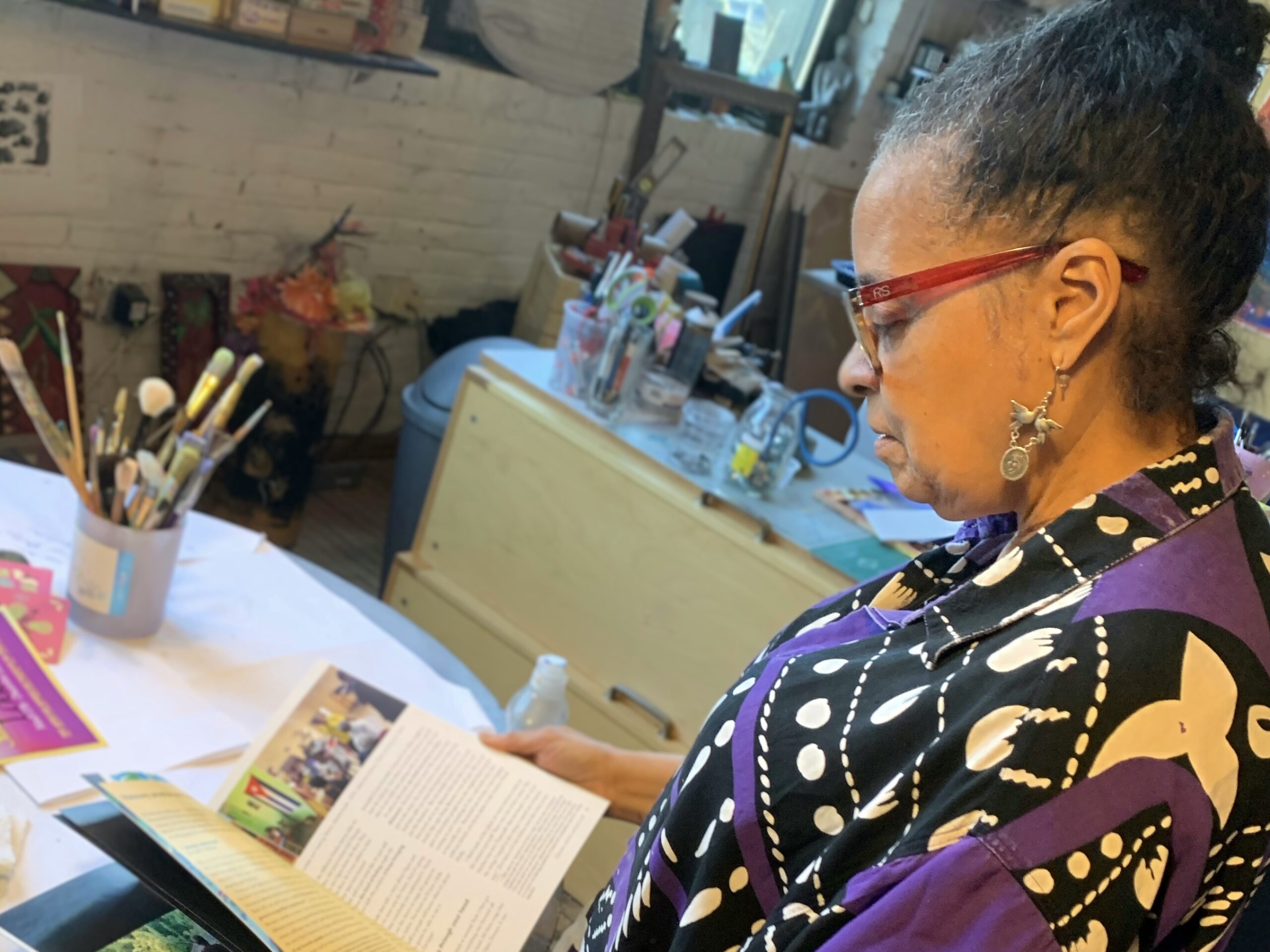
Ife Nii Owoo, in her studio space at Greene Street Artists Cooperative, looks through her variety of work. (Photo: Maleka Fruean)
In Germantown, it’s no secret that there are award-winning Black women artists and poets everywhere you look. Ife Nii-Owoo is one of the artists in this long neighborhood tradition of creativity and artmaking.
Ife Nii-Owoo started as a painter, using the medium as her main artistic expression. But her art moved into printmaking, graphic design, and mixed media collage as life progressed.
She’s lived in Germantown for decades as part of the Greene Street Artist Cooperative, also home to former poet laureate Trapeta Mayson and visual artist Barbara Bullock.
In 2022, she won the Leeway Transformation Award, an unrestricted $15,000 award for women, trans, and gender non-conforming artists in the Greater Philadelphia area creating art for social change.
And in 2024, she had a solo exhibition, Ife Nii-Owoo: The Shape of My Heart, at Allens Lane Art Center.
The current phase of life is focusing on her own art. But Nii-Owoo wasn’t always focusing on her own pieces. After moving to London in the ‘70s, she worked on printmaking and designing political posters for African social movements.
The designs captured some of the turmoil and cultural shifts that were happening across the world with African people from both the continent and the wider diaspora who were immigrants. It wasn’t necessarily her own art, but it did help define for her what a cultural worker was, and it became one of her ways of being in the world for the rest of her life.
“We were talking about centering, you know, breaking away from colonial mentalities of always seeing outside of ourselves or more inside of ourselves, and then also using the artwork as a tool, you know, to organize, to educate, to propaganda, to use it in that way. So that’s my definition of a culture worker,” said Nii-Owoo.
She and her husband at the time then moved to Ghana, where she studied African Visual Arts.
When she returned to Philadelphia, she was raising her two sons and also taught herself graphic design. She worked on book covers for radical and progressive presses like Black Classic Press and partnered with the Philadelphia Folklore Project on art that helped represent the projects and storytelling they were doing.
She even started working in cultural healthcare and branding identity work, and said her focus was on helping educate people with cultural competency in the healthcare industry.
But after some time away, in the last ten years, Nii-Owoo has really focused again on creating her own work.
Nii-Owoo works in her studio every day and is currently creating pieces in multiple series that involve her own intimate story and her family’s story, as well as present social movements. Her work includes elements of mixed media, collage, painting, and prints.
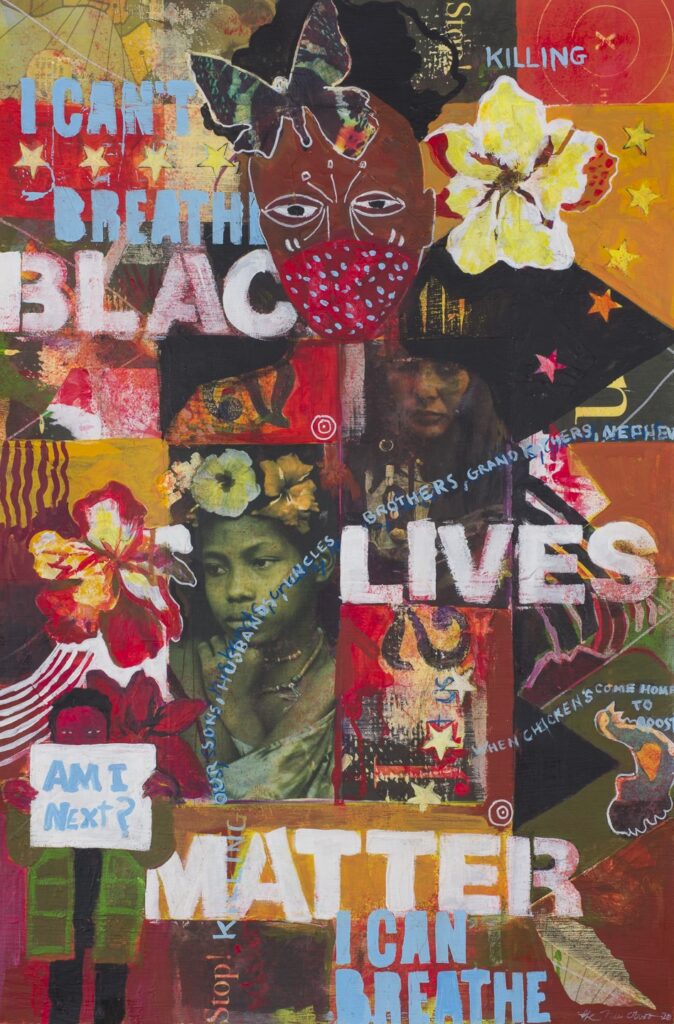
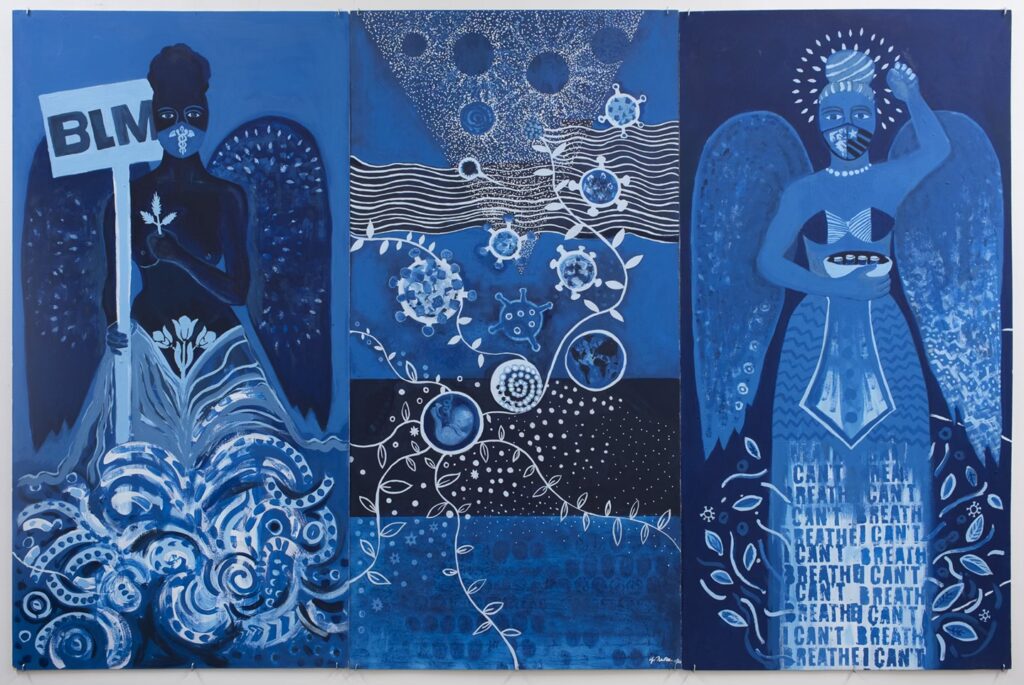
One series is focused on the body.
“This one up here is just dealing with the body and reproduction and Roe vs. Wade. I just always feel like these young girls, like here … (pointing to images) we had choices, and our choices are not with us anymore.”
Other themes that have come up in her work, especially during the pandemic and afterward, are social justice movements like Black Lives Matter. More intimately, stories of her family and grief are present.
Nii-Owoo’s mother passed away in recent years. She was also an artist and an art teacher, and one of Nii-Owoo’s large paintings displayed in the Greene Street Artists Cooperative hallway is a recreated piece based on her mother’s unfinished watercolor paintings called Water Lilies.
Another familial theme that comes up is Nii-Owoo’s migration stories. Her grandparents migrated from South Carolina to the North in the 1920s.
According to Nii-Owoo, her grandfather was sent up to New Jersey as a 12-year-old under the pretense of being educated but was actually working as an indentured servant for Quakers on a chicken farm. He eventually made his way to Philadelphia. Her grandmother’s experience was her family being separated from each other during the Great Depression because her parents had lost everything, including the barbershops they had owned.
The two found each other in Philadelphia, and Nii-Owoo captures their journey in a large piece she calls “Crossing the Color Line.” She said they both considered themselves “colored,” whereas her generation shifted to calling themselves “diaspora African” or “African descent.”
She plays a lot with repetition and pattern, inspired by traditional quilts from Gee’s Bend, textiles of Africa, and symbolism from African and other world cultures.
She’s teaching workshops now at New Courtland Senior Housing that remind her of just how meaningful our family connections are. Her ‘Fans of Homage” workshop had folks working with collage making, painting, photo transfer, and found objects on fans to create personal memoirs. She asks the seniors what their legacy is and what they want to leave. Most point to their grandchildren and family.
She likes using art as a way of helping people heal, especially seniors.
And for the future? Nii-Owoo wants to continue working. She wants to travel more and attend more art residencies. She wants to incorporate and share the commonalities in the work that different movements are doing. She wants to be out in the world but also wants solitude and time to keep creating.
“I’m grateful for my space. I’m grateful that I have a community that I can interact with. I’m grateful for what’s going on with many young people with their ideas of resistance,” says Nii-Owoo.